
Sri Anegudde Vinayaka Temple, Kumbashi
The sacred abode of Lord Ganesha on the Karnataka coast.
Sri Anegudde Vinayaka Temple, at Kumbashi in Kundapura taluk of Udupi district, is one of the most revered temples dedicated to Lord Ganesha in South India. Set atop a small hillock amid the lush coastal landscape, it has been a centre of faith, devotion and pilgrimage for centuries, drawing devotees from Karnataka, Kerala, Tamil Nadu, Andhra Pradesh, Maharashtra and across India who come to seek the blessings of Lord Vinayaka, the remover of obstacles and the bestower of wisdom, prosperity and success.
Anegudde is not merely a place of worship; it is a spiritual institution woven deep into the cultural and religious fabric of coastal Karnataka. Its ancient legends, unique traditions, architectural beauty and vibrant festivals have made it one of the most important Ganapathi temples of the region, and a visit here is considered especially auspicious before embarking on a journey, beginning a new venture, pursuing education, or undertaking any significant life event.
Meaning of the name
The name Anegudde comes from two Kannada words (ane, meaning "elephant," and gudde, meaning "hill") so Anegudde literally translates to "Elephant Hill." The temple sits on a small hill that, by local belief, resembles the shape of an elephant, and the name connects symbolically to Lord Ganesha, whose elephant-headed form is among the most recognisable in Hinduism. The natural elevation lends the site a sense of spiritual ascent, the atmosphere deepening as devotees climb toward the shrine.
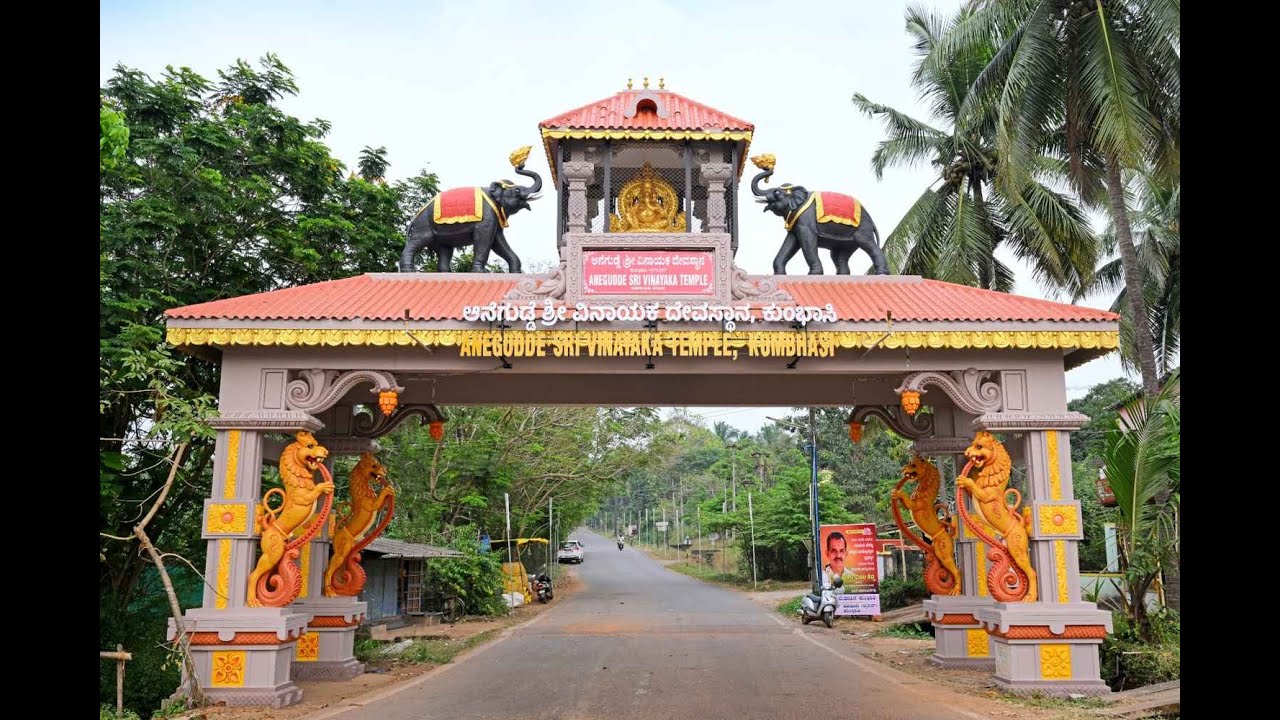 Temple gateway, Kumbashi
The sacred legend
The origins of the temple are rooted in ancient mythology. By tradition, the region around present-day Kumbashi was once home to sages and ascetics devoted to meditation and spiritual practice, among them the revered Sage Agastya. During this period a demon named Kumbhasura began terrorising the area, possessed of extraordinary powers, he disrupted religious life and spread fear among the sages and inhabitants.
Unable to withstand the demon's oppression, the sages prayed to Lord Ganesha for protection. Moved by their devotion, Lord Vinayaka manifested himself and confronted Kumbhasura. A fierce battle followed, and ultimately the Lord defeated the demon and restored peace to the land. After the victory, the sages asked the Lord to remain permanently to protect future generations; Lord Vinayaka agreed, and his presence became established at Anegudde, the legend that still forms the spiritual foundation of the temple's significance. The place-name Kumbashi itself recalls the demon Kumbhasura.
Historical background
Although precise records of the temple's origin are limited, local tradition holds that the shrine has stood for several centuries, growing gradually from a small place of worship into a major pilgrimage centre. Successive generations of devotees, local rulers, merchants and religious leaders contributed to its development. Its position along ancient trade and pilgrimage routes made it especially important, travellers would stop at Anegudde to seek divine blessings before continuing their journeys, and over time the temple gained wide recognition as a powerful centre of Ganapathi worship.
The presiding deity
The principal deity is Lord Vinayaka, worshipped as Sri Anegudde Vinayaka in a standing form. The idol is regarded as highly sacred and spiritually potent, believed to remove obstacles, grant success and offer guidance through difficult circumstances. The Lord is honoured here under many names, each capturing a facet of his grace.
| Name | Meaning |
|---|---|
| Vighneshwara | Remover of obstacles |
| Siddhi Vinayaka | Bestower of success |
| Ganapathi | Lord of the Ganas |
| Buddhi Pradayaka | Giver of wisdom |
| Mangala Murthy | Bringer of auspiciousness |
The deity draws people from every walk of life, students, professionals, businesspersons, farmers, artists and spiritual seekers alike.
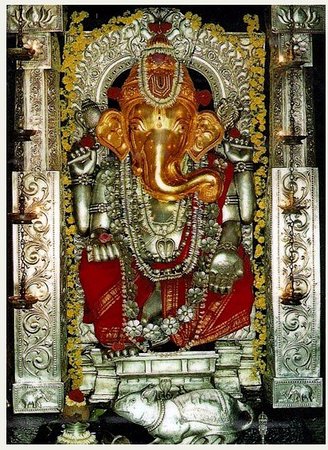
Why Ganapathi is worshipped first
In Hindu tradition Lord Ganesha occupies a unique position, invoked before any auspicious undertaking. Devotees traditionally seek his blessing before beginning a journey, starting education, entering a new home, commencing business, performing religious ceremonies or making major life decisions. This belief has done much to build Anegudde's popularity: many devotees make it a practice to visit before important milestones, and the temple is especially beloved of students appearing for examinations and entrepreneurs launching new ventures.
Temple architecture
The temple reflects the distinctive architectural style of coastal Karnataka, combining traditional temple design with practical adaptations for the region's heavy monsoon, the steep tiled roofs and stone vimana seen rising above its orange walls. Its principal elements together create an atmosphere of devotion, serenity and spiritual focus.
- Garbhagriha
- The sanctum sanctorum housing the sacred idol of Lord Vinayaka, the spiritual heart of the temple, where daily worship is performed.
- Mukhamantapa
- The entrance hall, a gathering space for devotees that accommodates religious ceremonies.
- Deepastambha
- The traditional lamp pillar standing prominently in the complex, illuminated during important festivals.
- Balipeetha
- The ritual altar, occupying an important position in the temple's layout.
- Courtyard
- A spacious court that lets devotees take part in festivals and special ceremonies.
Daily rituals and worship
The temple follows a well-established schedule of daily worship that maintains its spiritual energy. The day begins with the opening of the sanctum and the awakening rituals of the deity, followed through the day by the principal services.
| Ritual | What it involves |
|---|---|
| Abhisheka | Sacred bathing of the deity with water, milk, coconut water, honey and sandalwood paste. |
| Alankara | Adorning the deity with flowers, ornaments and traditional decorations. |
| Archana | Special prayers and the chanting of the sacred names of the Lord. |
| Maha Mangalarati | The main worship, culminating in the waving of lamps before the deity. |
| Prasada | Distribution of the blessed offerings among devotees. |
Offerings and sevas
The temple offers many forms of worship and devotional service, sponsored by devotees as expressions of gratitude or prayer. Popular offerings include modaka, coconut, banana, durva grass and flower garlands, alongside the Tulabhara (offering of goods weighed against the devotee) and special Archana.
Festivals
The temple calendar is rich with celebration, three observances above all marking it as a major Ganapathi centre.
Ganesh Chaturthi
The most important festival at Anegudde. The temple is beautifully decorated, thousands of devotees arrive each day, and special poojas, cultural programmes and religious discourses fill the air with devotion and celebration.
Sankashti Chaturthi
Of special significance here. Devotees observe fasting and gather in large numbers seeking relief from obstacles and difficulties, in the belief that prayers offered on this day receive the Lord's special blessing.
Annual Rathotsava
One of the grandest events of the year. The decorated chariot bearing the deity is drawn through the temple surroundings by devotees, with processions, devotional music and cultural performances binding temple and community together.
Pilgrimage tradition
For generations Anegudde has formed an important part of the pilgrimage routes of coastal Karnataka. Many pilgrims combine a visit here with the great shrines nearby, most often Kollur Mookambika, the Hattiangadi Siddhi Vinayaka temple and the Shankaranarayana temple, a living tradition that continues to flourish and reinforces Anegudde's standing on the coast.
Role in community life
Beyond worship, the temple is a centre of community engagement, supporting religious education, cultural preservation, charitable initiatives, the organisation of festivals and community gatherings. It continues to play a vital part in sustaining traditional values and social cohesion across the surrounding villages.
Visiting
Kumbashi lies just off NH 66, an easy stop between Kundapura and Maravanthe, and is most often visited together with Kollur. Devotees are requested to dress in traditional attire within the temple. See the travel guide for routes and timing.
See also
References & notes
- Compiled report: "Sri Anegudde Vinayaka Temple, Kumbashi, the Sacred Abode of Lord Ganesha."
- Anegudde Sri Vinayaka Temple administration, Kumbashi.
- Coastal Karnataka pilgrimage-circuit notes and local oral tradition.
Photographs were contributed by residents and visitors documenting the temple, and are used for educational and cultural reference, not for commercial purposes.